They say everything is bigger in Texas—but that idea falls apart fast once you look to Japan. You might think the Rockin’ 1000 is the ultimate giant music event. Think again. Every December since 1983, Japan has pulled off something almost unreal: a choir of 10,000 people coming together to sing the powerful final part of Beethoven’s Ninth Symphony. Add a full orchestra to that, and the sound becomes overwhelming in the best way possible.

Japanese mega-choir with 10,000 singers perform Beethoven's 'Ode to Joy'

They say everything is bigger in Texas. Think again. You think the Rockin’ 1000 is a massive music performance group? Think again. Every year since 1983, a choir of 10,000 singers has gathered to sing the choral climax of Beethoven’s Ninth Symphony in December in Japan. Add to that the members of the orchestra, and you get a monumental performance.

Japanese mega-choir with 10,000 singers perform Beethoven's 'Ode to Joy'

The following video was recorded in December 2011. It is conducted by Yutaka Sado, the General Director and conductor of the choir since 1999. A Japanese conductor who studied under Seiji Ozawa & Leonard Bernstein, Yutaka Sado became the Music Director of Austria’s oldest orchestra, the Tonkünstler Orchestra (1st performance, 1907) in 2015.

Jonathan Lauzon pithily comments, “Composed by a German legend, sung by a Japanese multitude, gave chills to a Canadian nobody.” GoodVibes1997 says, “As a German, I’m impressed by the perfect pronunciation, the orchestra & the sheer number of musical talent.” The quality of the singing becomes more remarkable when one realises that most of the singers are amateurs who bulk up professional soloists and a chamber choir. Applications to sing are oversubscribed, so it is a privilege to be selected.

In Japan, Beethoven’s Ninth has become associated with Christmas time, In shopping malls, in community centres, and in concert venues, there are 100s of performances of the Ninth. Many include singalongs to the “Ode to Joy,” the choral part of the symphony’s 4th movement, which is associated with peace, hope, and joy. The libretto of the choral section is from a 1785 poem by Friedrich Schiller. Here is a heart-warming mini documentary on the annual 10 000 singer performance of Ode to Joy.

In the documentary, conductor Yutaka Sado perceptively notes that “having 10 000 singers is amazing, but if they’re not into it, it would be depressing. I need to make them feel like they’re not one of 10 000; that everyone has the main role. That’s been my biggest challenge from the first year and still is today.”

The story of the first performance of Beethoven’s Ninth in Japan has become legendary. This performance occurred in the closing stages of World War One. During the war, about 1000 German prisoners of war were confined at Bando Camp. The camp was humanely run, and there was sporting and cultural contact between the prisoners, Japanese guards and local inhabitants. A German prisoner named Paul Engel was allowed to teach music in the camp. Twice a week, he was allowed to give lessons to interested Japanese people outside the camp.

Apparently the camp came to have 2 orchestras with 45 members each, 2 brass bands, and 2 sixty-member-strong choirs. More than 80 prisoners spent months mastering Beethoven’s Ninth which was played in Barrack One of Bando camp on 1 June 2018, becoming the first performance in Japan.

The tradition of the 10 000 strong Daiku (literally nine, as in Beethoven’s 9th) persisted during the pandemic. In 2020, the 250th anniversary of Beethoven’s birth, the event was virtual for the first time. Singers from around the world submitted videos and there were 11,961 singing videos accompanying the live orchestra. In 2021, the event was held as a combination live and virtual concert. Take a look:

Speaking of the Japanese love for the choral section of Ode To Joy, Toshiaki Kamei, the director of the All-Japan Association of Daiku Choral Societies says “Nowadays, we observe many conflicts between different religions or different ethnic groups happening around the world. We believe singing Daiku together with people from various cultural backgrounds helps us learn to accept diversity and promote world peace.

Related Posts

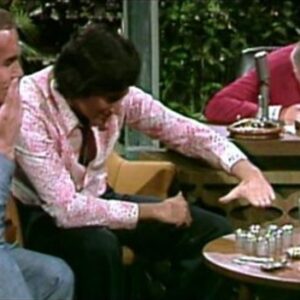
“GET OUT RIGHT NOW” — Johnny Carson rarely hated anyone… but there was one guest he was determined to expose on live TV. That guest was Uri Geller — the famous mentalist known for bending spoons with “his mind,” and according to the book Love Johnny Carson, Carson quietly set up a major move before the cameras rolled. Once the segment started, everything suddenly went off track, stretching to 28 minutes with almost no way to save it, leaving Geller embarrassed on American television.

The One ‘Tonight Show’ Guest Johnny Carson Absolutely ‘Despised’: ‘He Hated Phony’ As Mark Malkoff’s illuminating new book Love Johnny Carson quickly points out, the iconic late night talk…

This morning, something unbelievable took over the heart of London as more than 20,000 people flooded the city streets for the “Jesus Parade 2025,” turning busy roads into something that felt holy and alive. Cars disappeared, noise faded, and in their place came singing, prayer, and a deep sense of togetherness. “I’ve never seen anything like this,” one marcher said softly, wiping away tears as songs echoed where horns usually blare.

Inside the 2025 London Jesus Parade — A Joyous, Ancient Biblical Procession That Captured Hearts Across the City On a crisp Sunday morning in the heart of…

“HE THOUGHT STAYING HOME WOULD BE EASY.” Netflix has just unleashed a family comedy so chaotic it turns confidence into full-blown panic. Nate Bargatze plays a breadwinner who proudly believes the office grind is harder than home life — until his wife, played by Mandy Moore, lands a massive Shark Tank–style deal and leaves him in charge. What follows is pure disaster: missed school runs, emotional implosions, laundry gone wrong, and a slow, hilarious unraveling as he realizes the job he mocked might be the hardest one there is. It’s loud, messy, and relentlessly funny — but beneath the laughs is a sharp, surprisingly heartfelt reckoning about ego, parenting, and who actually holds a family together. By the end, viewers aren’t just laughing — they’re rethinking everything they thought they knew.

Comedian Nate Bargatze has charmed audiences with his clean, relatable stand-up routines, often drawing from his Tennessee roots and everyday absurdities. Now, the “down-to-earth guy” is making…

As Christmas gets closer, this is the performance people come back to year after year—and it never loses its magic. ❄️ Team USA’s Olympic ice skaters took to the ice and turned Metallica’s “Nothing Else Matters” into something unforgettable. Every glide, every lift, every quiet moment felt heavy with emotion, like time slowed down just to watch them move. By the end, the crowd was speechless—and so was the internet. What started as a bold song choice became one of the most watched ice dance routines ever, proving that when passion meets music, nothing else really matters.

Heavy Metal has never been so elegant! This is team USA ice dancers, Oona & Gage Brown, showcasing their incredible skills on the ice. The awesome camera…

He wasn’t meant to be the star of the moment—but the second Tim Conway walked out dressed as a lion, everything went off the rails. 🦁 What should’ve been a simple sketch on The Carol Burnett Show turned into pure chaos when Conway’s “lazy lion” started doing all the wrong things at all the wrong times. He growled when he shouldn’t, scratched himself in the middle of the scene, and completely shattered Carol Burnett’s composure on live TV. Harvey Korman fought to stay serious, but it was a losing battle—every glance at Conway made him crack. 😂 The mane kept slipping, the roars got stranger by the second, and the audience was laughing so hard they could barely breathe. By the end, it wasn’t even a sketch anymore—it was Tim Conway in full control, tearing through the scene and proving once again that when he goes wild, comedy doesn’t stand a chance.

When Tim Conway prowled onto The Carol Burnett Show stage dressed as a lion, nobody — not even Carol Burnett — was prepared for what came next. With a…

“THIS MAKES STRANGER THINGS FEEL LIKE CHILD’S PLAY.” That’s the reaction detonating online as one of Stephen King’s darkest adaptations finally arrives on Netflix this December 16. Set in King’s most cursed small town, the series follows Henry Deaver’s return home — and the nightmare that begins the moment a mysterious young man is discovered locked deep inside Shawshank Prison. From there, the town fractures: buried sins surface, reality bends, and an ancient evil starts breathing again. This isn’t jump-scare horror or nostalgic fun — it’s slow, icy, and psychologically brutal, the kind that crawls under your skin and refuses to leave. Viewers are warning each other already: once you start, there’s no safe stopping point.

One of the best Stephen King adaptations officially has a new  streaming home. The hit Stephen King-inspired series Castle Rock has finally made its way to the biggest streaming platform online. As of…